
Centrelink Data Matching Crackdown 2026
Complete guide to the Centrelink Data Matching Crackdown 2026 — how audits work, who is at risk, what triggers a review, and how to protect your payments.
Table of Contents
The Centrelink Data Matching Crackdown 2026 is already running across Australia right now. Services Australia is cross-checking every Centrelink recipient’s reported income, assets, and personal circumstances against real-time data from the ATO, banks, employers, and Medicare. Even a minor reporting error can trigger a Centrelink audit in 2026 and put your payments at immediate risk.
1. What Is the Centrelink Data Matching Crackdown 2026?
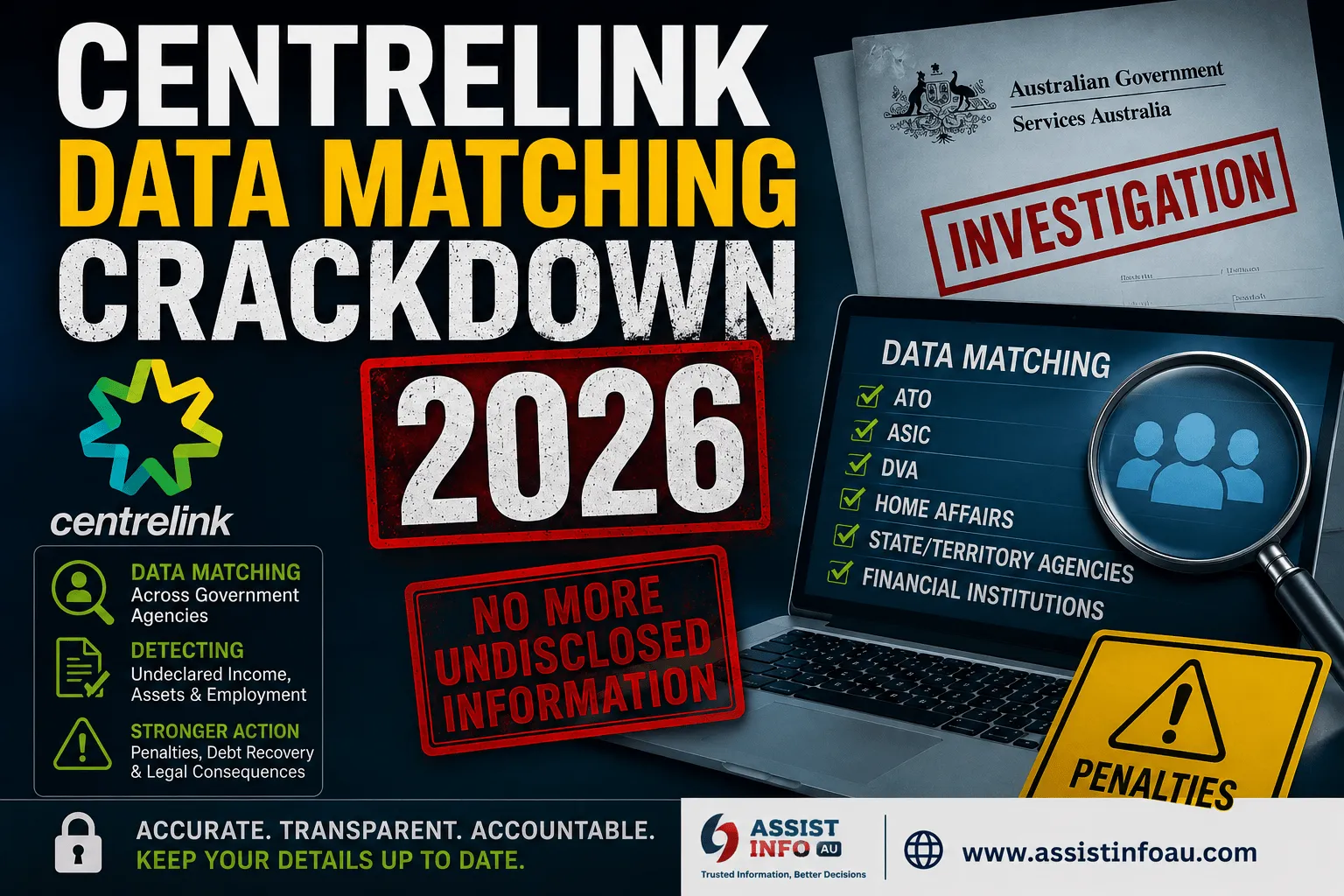
The Centrelink Data Matching Crackdown 2026 is a major escalation of Services Australia’s automated compliance program that electronically cross-checks every welfare recipient’s reported details against data held by the ATO, banks, employers, Medicare, and other government agencies — in real time, every single week.
Unlike previous compliance programs, the Centrelink data matching crackdown 2026 does not wait for you to lodge a tax return. It runs continuously, 24 hours a day, 7 days a week, automatically flagging discrepancies the moment they appear. All Centrelink recipients — including JobSeeker, Age Pension, Disability Support Pension, and Family Tax Benefit — are subject to this real-time monitoring in 2026.
2. How Does Centrelink Data Matching Work in 2026?
The Centrelink data matching 2026 system works by electronically comparing your reported details against data from multiple external agencies. According to Services Australia’s data matching program reports, the 2026 system has been upgraded with powerful new capabilities:
- Real-time continuous checking: The 2026 Centrelink audit system checks your data continuously — not once a year, but every single week as new data flows in from the ATO and employers.
- AI-powered anomaly detection: Machine learning algorithms flag unusual patterns — such as sudden income changes or undeclared employment — automatically without human intervention.
- Single Touch Payroll (STP) direct feed: Under the ATO’s STP system, every employer in Australia reports payroll to the ATO every pay cycle. The ATO sends approximately 100,000 employer records to Centrelink every week — meaning your casual shift from last Tuesday may already be visible to Centrelink before your next reporting deadline.
- Expanded data sharing partners: The Centrelink data matching crackdown 2026 now draws on more agencies than ever — including state revenue offices, the Department of Home Affairs, and superannuation funds.
3. Who Is Affected by the Centrelink Data Matching Crackdown 2026?
Every single person receiving any Centrelink payment in Australia in 2026 is subject to data matching. However, certain payment types carry a significantly higher risk of triggering a Centrelink audit 2026. Here is the full breakdown:
| Centrelink Payment Type | Most Common Risk Factor | 2026 Risk Level |
|---|---|---|
| JobSeeker Payment | Undeclared casual or part-time employment income | 🔴 Very High |
| Age Pension | Undeclared assets, investments, or superannuation | 🔴 Very High |
| Disability Support Pension (DSP) | Earning above the income threshold | 🟠 High |
| Family Tax Benefit (FTB) | Undeclared partner income or relationship status change | 🟠 High |
| Youth Allowance | Undeclared casual work or change in study load | 🟠 High |
| Parenting Payment | Change in relationship status or partner employment | 🟡 Medium |
4. What Data Does Centrelink Match in 2026?

The Centrelink Data Matching Crackdown 2026 draws on a wider range of data sources than most recipients realise. Understanding exactly what data Centrelink can access is critical to protecting your payments.
4.1 Australian Taxation Office (ATO) — Primary Source
The ATO is Centrelink’s most important data partner. The ATO shares wage income, interest, dividends, rental income, and self-employment income with Centrelink up to 9 times per year — and payroll data via STP weekly.
4.2 Banks and Financial Institutions
Banks report interest earned on savings accounts, term deposits, and other products to the ATO and Centrelink. The Centrelink data matching crackdown 2026 can detect large unexplained deposits or asset growth that does not match declared income.
4.3 Employers via Single Touch Payroll (STP)
Every registered Australian employer reports payroll to the ATO via STP at every pay run. This means your employment income is visible to Centrelink within days — or even hours — of being paid. This is the most powerful tool in the Centrelink 2026 audit arsenal.
4.4 Other Agencies
Medicare, the Department of Home Affairs, state revenue offices, and superannuation funds all share data with Centrelink to verify identity, residency, assets, and other eligibility criteria.
5. The Scale of the Crackdown: Key Statistics
6. What Triggers a Centrelink Audit in 2026?
The most common triggers under the Centrelink data matching crackdown 2026 are:
- Undeclared employment income: The leading cause of flags. Even one unreported casual shift detected through STP payroll data can trigger a formal review.
- Gig economy and freelance earnings: Income from rideshare, food delivery, Airtasker, or any online platform is visible to the ATO.
- Undeclared relationship changes: Moving in with a partner, or a relationship ending, without updating Centrelink is a common trigger for Family Tax Benefit reviews.
- Undeclared assets: Property or vehicles purchased, inherited, or sold without notification.
- Excessive overseas travel: Home Affairs travel records flag departures exceeding the allowable period for your payment.
7. What Happens If Centrelink Finds a Discrepancy in 2026?
- Automated flag generated: The Centrelink data matching crackdown 2026 system detects a discrepancy.
- Review notice sent: Centrelink contacts you via myGov inbox, by letter, or by phone, asking you to verify or explain.
- Response window: You are given a specific period to provide evidence. This is your most important opportunity.
- Human officer review: Unlike Robodebt, the Centrelink 2026 audit process requires a trained officer to review your response.
- Decision issued: Your payments may continue, be adjusted, suspended, or you may receive a formal debt notice.
8. How to Protect Your Centrelink Payments in 2026
- Declare Every Dollar of Income: Under the Centrelink data matching 2026 program, every dollar of income is visible — eventually. Declare all wages, freelance payments, gig economy earnings, rental income, and bank interest.
- Update Your myGov Profile Immediately: Every time your life circumstances change — new relationship, new job, overseas travel, asset change — update your Centrelink record in myGov immediately.
- Check Your myGov Inbox Regularly: The Centrelink 2026 audit process always starts with a notification. Check your inbox every two to three days.
- Keep Financial Records for 5 Years: Payslips, bank statements, rental receipts, and copies of every Centrelink income report you submit.
9. Is the Centrelink Data Matching Crackdown 2026 the New Robodebt?
| Feature | Robodebt (Illegal 2015–2019) | Centrelink Data Matching Crackdown 2026 |
|---|---|---|
| Income calculation | Averaged annual income | Actual weekly payroll data via STP |
| Human review | Largely absent | Required before any debt is confirmed |
| Legal basis | Unlawful | Operates under updated, lawful framework |
| First contact | Debt demand letter | Review notice — response requested first |
10. Your Complete 2026 Centrelink Compliance Checklist
- ✅ All employment income — including every casual and part-time shift — reported on time
- ✅ Freelance, gig economy, or any self-employment income declared
- ✅ Rental income from any property or room reported
- ✅ Bank interest, dividends, and investment returns declared
- ✅ Current relationship status is accurate in myGov
- ✅ Residential address is current in myGov
- ✅ Any overseas travel reported if it exceeds the allowable absence period
- ✅ All assets — property, vehicles, shares, crypto — accurately declared
- ✅ myGov inbox checked every 2–3 days for Centrelink messages
- ✅ All Centrelink review notices responded to within the deadline
- ✅ Financial records kept for at least 5 years
🔔 Stay Ahead of Centrelink Changes in 2026
Get the latest Centrelink payment news, compliance updates, and rate changes — so the Centrelink Data Matching Crackdown 2026 never catches you off guard.
Visit Our Full Centrelink Payments Hub →11. Frequently Asked Questions
What is the Centrelink Data Matching Crackdown 2026?
It’s an automated, continuous compliance program that cross-checks your declared income, assets, and circumstances against real-time data from the ATO, banks, employers, and other agencies.
Who is affected?
Every Centrelink recipient, including JobSeeker, Age Pension, DSP, Family Tax Benefit, and Youth Allowance holders.
Can a small mistake trigger an audit?
Yes. Even a single undeclared casual shift or unreported bank interest can trigger a review.
Is this the same as Robodebt?
No. It uses real weekly payroll data, not income averaging, and requires human review before any debt is confirmed.
Official Sources
Disclaimer: This guide provides general information about the Centrelink Data Matching Crackdown 2026 and related services. We are an independent publisher and are not affiliated with Services Australia, Centrelink, or any Australian Government department, and we cannot access or change your personal Centrelink record.
Rates, thresholds and rules are set by the Australian Government and can change without notice. This article was updated in July 2026 — always confirm current details at servicesaustralia.gov.au.