
Centrelink Data Matching Crackdown 2026: What Every Australian Must Know
Centrelink Data Matching Crackdown 2026 — Services Australia Audit Australia ⚠️ Updated — June 2026

Centrelink Data Matching Crackdown 2026: What Every Australian Welfare Recipient Must Know Right Now

Published: June 16, 2026  |  Updated: June 17, 2026  |  Category: Centrelink Payments  |  By: AssistInfoAu Editorial Team

⚡ Key Summary: The Centrelink Data Matching Crackdown 2026 is already running across Australia right now. Services Australia is cross-checking every Centrelink recipient’s reported income, assets, and personal circumstances against real-time data from the ATO, banks, employers, and Medicare. Even a minor reporting error can trigger a Centrelink audit in 2026 and put your payments at immediate risk.
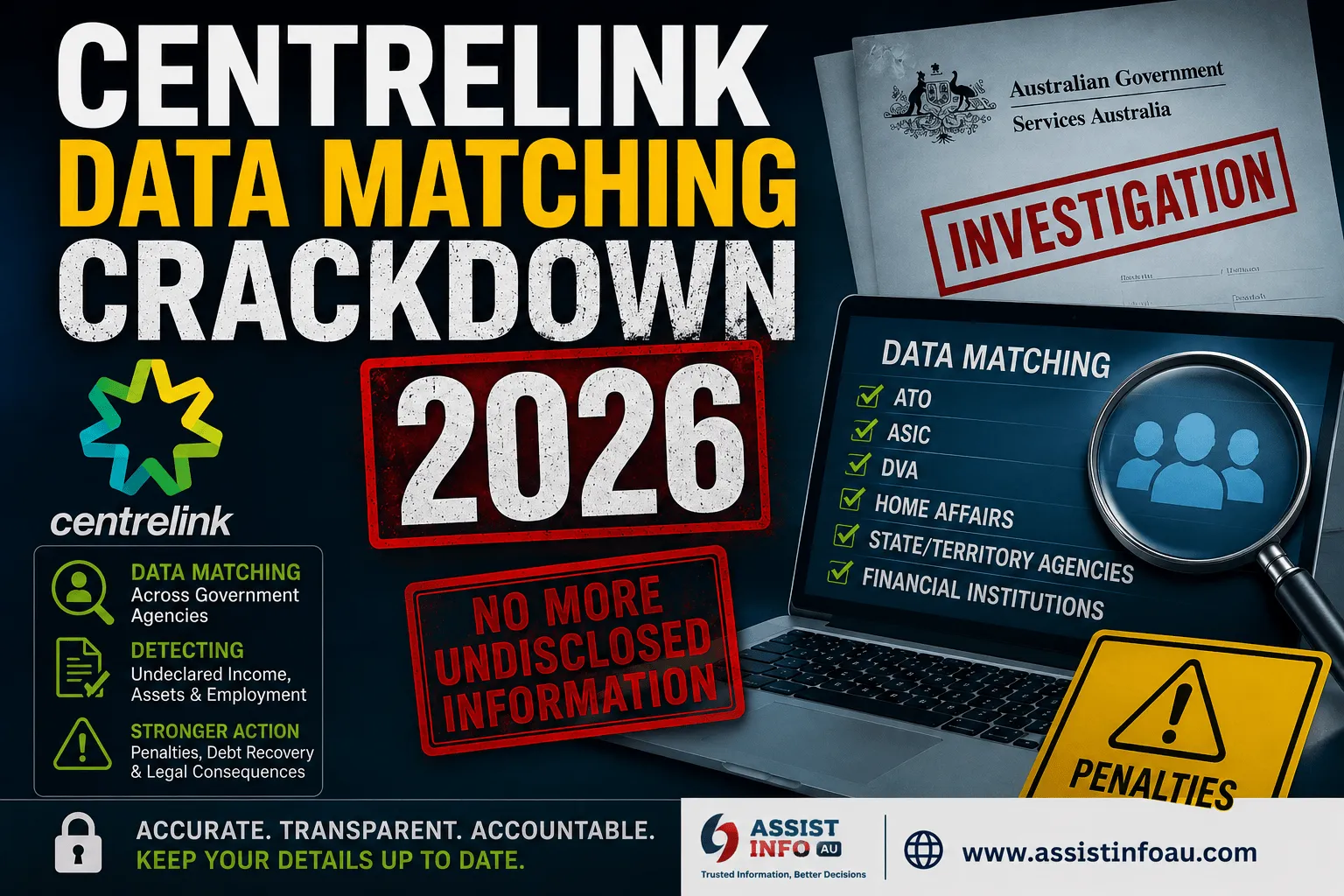
1. What Is the Centrelink Data Matching Crackdown 2026?

The Centrelink Data Matching Crackdown 2026 is a major escalation of Services Australia’s automated compliance program that electronically cross-checks every welfare recipient’s reported details against data held by the Australian Taxation Office, banks, employers, Medicare, and other government agencies — in real time, every single week.

Unlike previous compliance programs, the Centrelink data matching crackdown 2026 does not wait for you to lodge a tax return or make a formal complaint. It runs continuously, 24 hours a day, 7 days a week, automatically flagging discrepancies the moment they appear. Centrelink recipients across Australia — including JobSeeker, Age Pension, Disability Support Pension, and Family Tax Benefit recipients — are all subject to this real-time monitoring in 2026.
The Centrelink data matching 2026 program is not targeting only deliberate fraudsters. In fact, Services Australia’s own data shows that the majority of discrepancies found are the result of honest reporting errors — income forgotten, circumstances not updated, or payment rules misunderstood. For this reason, every Centrelink recipient in Australia needs to understand the 2026 crackdown and what it means for their payments.

⚠️ Warning: The Centrelink Data Matching Crackdown 2026 is automated and continuous — it never stops. You cannot predict when your file may be flagged. The safest approach is to ensure your myGov details are always 100% accurate and up to date.

2. How Does Centrelink Data Matching Work in 2026?

The Centrelink data matching 2026 system works by electronically comparing the personal and financial information you have provided to Centrelink against data held by multiple external agencies. According to Services Australia’s data matching program reports, the 2026 system has been upgraded with several powerful new capabilities:

  • Real-time continuous checking: The 2026 Centrelink audit system checks your data continuously — not once a year or at claim time, but every single week as new data flows in from the ATO and employers.
  • AI-powered anomaly detection: Machine learning algorithms now flag unusual patterns — such as sudden income changes, undeclared employment, or lifestyle spending that does not match declared income — automatically without human intervention.
  • Single Touch Payroll (STP) direct feed: Under the ATO’s STP system, every employer in Australia reports payroll to the ATO every pay cycle. The ATO sends approximately 100,000 employer records to Centrelink every week — meaning your casual shift from last Tuesday may already be visible to Centrelink before your next reporting deadline.
  • Expanded data sharing partners: The Centrelink data matching crackdown 2026 now draws on more agencies than ever — including state revenue offices, the Department of Home Affairs, and superannuation funds.
  • Automated overpayment calculation: When a discrepancy is detected, the system can automatically calculate a potential debt amount before any human officer reviews the case.

3. Who Is Affected by the Centrelink Data Matching Crackdown 2026?

The short answer is: every single person receiving any Centrelink payment in Australia in 2026 is subject to data matching. However, certain payment types carry a significantly higher risk of triggering a Centrelink audit 2026. Here is a full breakdown:

Centrelink Payment Type Most Common Risk Factor 2026 Risk Level
JobSeeker Payment Undeclared casual or part-time employment income 🔴 Very High
Age Pension Undeclared assets, investments, or superannuation 🔴 Very High
Disability Support Pension (DSP) Earning above the income threshold or working undeclared hours 🟠 High
Family Tax Benefit (FTB) Undeclared partner income or relationship status change 🟠 High
Youth Allowance Undeclared casual work or change in study load 🟠 High
Centrelink Rent Assistance Rental arrangement changes not reported 🟡 Medium-High
Parenting Payment Change in relationship status or partner employment 🟡 Medium
Carer Payment Improvement in care recipient’s condition 🟡 Medium

4. What Data Does Centrelink Match in 2026?

The Centrelink Data Matching Crackdown 2026 draws on a wider range of data sources than most recipients realise. Understanding exactly what data Centrelink can access in 2026 is critical to protecting your payments.

4.1 Australian Taxation Office (ATO) — Primary Source

The ATO is Centrelink’s most important data partner under the 2026 data matching crackdown. The ATO shares wage income, interest, dividends, rental income, capital gains, and self-employment income with Centrelink up to 9 times per year — and payroll data via STP weekly. If your tax return shows income you did not declare to Centrelink, the Centrelink data matching 2026 system will flag it automatically.

4.2 Banks and Financial Institutions

Under Australia’s financial reporting obligations, banks report interest earned on savings accounts, term deposits, and other products to the ATO and Centrelink. The Centrelink data matching crackdown 2026 can detect large unexplained deposits or asset growth that does not match declared income — even if your bank account has never been linked to Centrelink directly.

4.3 Employers via Single Touch Payroll (STP)

Every registered Australian employer reports payroll to the ATO via STP at every pay run. This means your employment income is visible to Centrelink within days — or even hours — of being paid, even for a single casual shift. This is the most powerful tool in the Centrelink 2026 audit arsenal and the most common source of data match discrepancies.

4.4 Medicare

Medicare data is used to confirm identity, detect duplicate claims, and — in some cases — identify undeclared care arrangements. If you receive a Centrelink Carer Payment, Medicare records relating to the care recipient may also be checked.

4.5 Department of Home Affairs

The Department of Home Affairs provides Centrelink with visa status records, citizenship data, and international travel departure and arrival information. The Centrelink data matching 2026 program uses this data to identify recipients who have been overseas longer than the allowable period for their payment type.

4.6 State and Territory Revenue Offices

Property ownership, land tax records, and vehicle registrations held by state revenue offices can reveal undeclared real estate assets or valuable vehicles that affect income and asset-tested Centrelink payments in 2026.

4.7 Superannuation Funds

Superannuation fund balances and pension payments are shared with Centrelink, particularly for Age Pension recipients, whose payment rates depend on total assets under the Centrelink assets test. The Centrelink data matching crackdown 2026 includes superannuation data updated regularly throughout the year.

5. Key Statistics: The Scale of the Centrelink Data Matching Crackdown 2026

100K Employer payroll records sent to Centrelink by ATO every single week
Per year the ATO sends income data updates to Centrelink
7+ Government agencies sharing data with Centrelink in real time in 2026
24/7 The Centrelink 2026 audit system runs continuously — never stops

6. What Triggers a Centrelink Audit in 2026?

Understanding what triggers a Centrelink audit 2026 is the single most important step you can take to protect your payments. The most common triggers under the Centrelink data matching crackdown 2026 are:

  • Undeclared employment income: The leading cause of Centrelink data matching 2026 flags. Even one unreported casual shift detected through STP payroll data can trigger a formal review.
  • Gig economy and freelance earnings: Income from rideshare, food delivery, Airtasker, Fiverr, Etsy, or any online platform is visible to the ATO and flows directly into the Centrelink 2026 audit system.
  • Undeclared relationship changes: Moving in with a partner, or a relationship ending, without updating Centrelink is one of the most common triggers for Family Tax Benefit and Parenting Payment reviews.
  • Undeclared assets: Property purchased, inherited, gifted, or sold without notifying Centrelink can be detected through state revenue and ATO data under the Centrelink data matching crackdown 2026.
  • Excessive overseas travel: Home Affairs travel records flag departures exceeding the allowable period for payments like Age Pension, which require Australian residency.
  • Rental income not declared: ATO rental income data feeds directly into the Centrelink data matching 2026 system. If you rent out a property — even a room on Airbnb — this income must be declared. See our Centrelink Rent Assistance guide for more details.
  • Bank deposits inconsistent with income: Large unexplained deposits or consistent spending well above declared income can trigger investigation.
  • Late or inconsistent reporting: A pattern of consistently late income reports to Centrelink can flag your account for increased scrutiny under the 2026 system.
🚨 Critical Warning: You do NOT need to have committed deliberate fraud to be caught by the Centrelink Data Matching Crackdown 2026. Accidental errors, reporting delays, and genuine misunderstandings about what counts as income are just as likely to trigger a Centrelink audit 2026 as intentional fraud. Ignorance is not accepted as a defence.

7. What Happens If Centrelink Finds a Discrepancy in 2026?

If the Centrelink data matching 2026 system flags your account, a structured process follows. Understanding this process can reduce the stress if it happens to you:

  1. Automated flag generated: The Centrelink data matching crackdown 2026 system detects a discrepancy between your declared information and data from an external source such as the ATO or an employer.
  2. Review notice sent: Centrelink contacts you — most commonly through your myGov inbox, by letter, or by phone — explaining what has been flagged and asking you to verify or explain.
  3. Response window: You are given a specific period to provide evidence, documents, or an explanation. This is your most important opportunity. Missing this window can result in automatic payment suspension.
  4. Human officer review: Unlike the illegal Robodebt scheme, the Centrelink 2026 audit process requires a trained officer to review your response before any debt or penalty is confirmed.
  5. Decision issued: Your payments may continue unchanged, be adjusted going forward, be temporarily suspended pending review, or you may receive a formal debt notice for overpayments already received.
  6. Fraud referral: In cases where deliberate fraud is suspected, the matter may be referred for formal investigation — potentially leading to fines, prosecution, or both.
✅ Reassurance: According to Services Australia, the vast majority of Centrelink data matching 2026 reviews are resolved without penalty once recipients provide clear documentation. Responding quickly and honestly is always the best strategy.

8. Real Australian Stories: How the Centrelink Data Matching Crackdown 2026 Is Affecting People

Sarah — Freelancer, Western Sydney

Sarah, a single mother receiving Family Tax Benefit, received a Centrelink data matching 2026 review notice about undeclared online income. She had been doing occasional freelance graphic design work and did not realise it needed to be declared to Centrelink. Her payments were temporarily reduced pending review. Once she provided her invoices and bank records, the matter was resolved — but the three weeks without full payment was financially devastating for her family.

Robert — Age Pensioner, Perth

Robert, a retiree, was contacted after the Centrelink Data Matching Crackdown 2026 flagged a discrepancy between his declared bank interest and what his financial institution reported to the ATO. “It was a tiny amount — maybe $80 in interest I’d forgotten about,” he said. “But it still triggered the whole review process.” The matter resolved within two weeks after he provided his bank statements.

Emily — JobSeeker Recipient, Melbourne

Emily accepted a two-week temporary role while receiving JobSeeker. She reported it to Centrelink but one day late. The Centrelink 2026 audit system had already flagged the payroll data from her employer via STP. She ended up with a small overpayment debt. “I knew I had to report it — I just didn’t know there was such a tight deadline,” she said.

These stories share a common thread: the people affected by the Centrelink Data Matching Crackdown 2026 are overwhelmingly ordinary Australians who made honest mistakes — not deliberate fraudsters. The system does not distinguish between intent and error at the detection stage.

9. How to Protect Your Centrelink Payments During the 2026 Crackdown

Protecting your payments during the Centrelink Data Matching Crackdown 2026 is entirely achievable if you take the right steps proactively:

9.1 Declare Every Dollar of Income — No Exceptions

Under the Centrelink data matching 2026 program, every dollar of income is visible — eventually. Declare all wages, freelance payments, gig economy earnings, rental income, investment returns, and bank interest. If you are unsure whether something counts as income under Centrelink’s rules, call the relevant Centrelink payment line and ask before your reporting deadline — not after.

9.2 Update Your myGov Profile Immediately When Circumstances Change

Every time your life circumstances change — new relationship, relationship breakdown, new address, new job, overseas travel, asset change — update your Centrelink record in myGov immediately. Do not wait until your next fortnightly reporting period. Changes that affect your payment rate must be reported within 14 days under Centrelink’s rules — and the Centrelink data matching crackdown 2026 will detect most changes before that deadline anyway.

9.3 Check Your myGov Inbox Regularly

The Centrelink 2026 audit process always starts with a notification. Check your myGov inbox every two to three days. Missing a review notice deadline can result in automatic payment suspension, even if you have done nothing wrong.

9.4 Keep Financial Records for a Minimum of 5 Years

Keep payslips, bank statements, rental receipts, investment records, and a copy of every Centrelink income report you submit. If a Centrelink data matching 2026 review is triggered, clear documentation is your best protection and fastest path to resolution.

9.5 Know Your Payment’s Specific Income and Asset Limits

Each Centrelink payment type has different income and asset thresholds. Check our complete Centrelink payment eligibility guide 2026 to understand exactly what limits apply to your payment — and how close to those limits you are currently operating.

9.6 Use the Express Plus Centrelink App for Fast Reporting

Download the Express Plus Centrelink mobile app to report income and update your details instantly from your phone. Fast reporting reduces the window in which the Centrelink data matching crackdown 2026 can detect a discrepancy before you have reported it.

9.7 Know Your Payment Dates to Detect Suspensions Early

Knowing your regular Centrelink payment dates 2026 means you will immediately notice if a payment is missing due to a data matching review — allowing you to act quickly before the situation escalates.

10. Is the Centrelink Data Matching Crackdown 2026 the New Robodebt?

The comparison to Robodebt is understandable — and important. The illegal Robodebt scheme, which ran from 2015 to 2019, was declared unlawful by the Federal Court and resulted in a $1.8 billion class action settlement. Here is how the Centrelink Data Matching Crackdown 2026 differs — and where risks still exist:

Feature Robodebt (Illegal 2015–2019) Centrelink Data Matching Crackdown 2026
Income calculation Averaged annual income (declared illegal) Actual weekly payroll data via STP
Human review Largely absent — automated debts sent directly Required before any debt is confirmed
Legal basis Unlawful — overturned by Federal Court 2019 Operates under updated, lawful framework
First contact Debt demand letter sent immediately Review notice sent — response requested first
Data sources ATO annual income data only (averaged) 7+ agencies, real-time weekly data feeds
Independent oversight None Governed by OAIC Data Matching Guidelines
✅ Important: The Centrelink data matching crackdown 2026 is legally and procedurally different from Robodebt. However, if you receive a debt notice you believe is incorrect, you have the right to appeal. Contact a community legal centre for free advice or call the Administrative Review Tribunal.

11. Your Complete 2026 Centrelink Compliance Checklist

Use this checklist to verify that you are fully protected against the Centrelink Data Matching Crackdown 2026. Review this list every fortnight before your income reporting deadline:

  • All employment income — including every casual and part-time shift — reported to Centrelink on time
  • Freelance, gig economy, Airtasker, Uber, or any self-employment income declared — even small amounts
  • Rental income from any property or room (including Airbnb) reported to Centrelink
  • Bank interest, share dividends, and investment returns declared
  • Current relationship status is accurate in myGov
  • Residential address is current and accurate in myGov
  • Any overseas travel reported if it exceeds the allowable absence period for your payment
  • All assets — property, vehicles, shares, savings, crypto — accurately declared
  • Superannuation balance updated with Centrelink (Age Pension recipients especially)
  • myGov inbox checked every 2–3 days for Centrelink messages
  • All Centrelink review notices responded to within the stated deadline
  • Financial records (payslips, bank statements, receipts) kept for at least 5 years
  • Express Plus Centrelink app installed for fast mobile reporting
  • Official Services Australia data matching page bookmarked for updates

🔔 Stay Ahead of Centrelink Changes in 2026

Get the latest Centrelink payment news, compliance updates, and rate changes — so the Centrelink Data Matching Crackdown 2026 never catches you off guard.

Visit Our Full Centrelink Payments Hub →

12. Frequently Asked Questions — Centrelink Data Matching Crackdown 2026

What is the Centrelink Data Matching Crackdown 2026? +
The Centrelink Data Matching Crackdown 2026 is an automated, continuous compliance program run by Services Australia that electronically cross-checks your declared income, assets, and personal circumstances against real-time data from the ATO, banks, employers, Medicare, and other government agencies. See the official Services Australia data matching page for full details.
Who is affected by the Centrelink data matching crackdown 2026? +
Every Centrelink recipient in Australia is subject to the Centrelink data matching 2026 program, including JobSeeker, Age Pension, Disability Support Pension, Youth Allowance, Family Tax Benefit, Parenting Payment, and Carer Payment holders.
What data does Centrelink match under the 2026 crackdown? +
The Centrelink Data Matching Crackdown 2026 draws on data from the ATO, banks, Medicare, employers (via Single Touch Payroll), the Department of Home Affairs, state revenue offices, and superannuation funds.
Can a small mistake trigger a Centrelink audit in 2026? +
Yes. The Centrelink data matching 2026 system detects even small discrepancies — including unreported bank interest, a single undeclared casual shift, or minor reporting delays. Always check our payment eligibility guide if you are unsure what to declare.
What happens if Centrelink finds a discrepancy during the 2026 crackdown? +
If the Centrelink Data Matching Crackdown 2026 flags your account, Centrelink will contact you via myGov or by letter, ask you to explain the discrepancy, review your response, and then decide whether to continue, adjust, or suspend your payments, or issue a debt notice.
How can I protect my payments during the Centrelink data matching crackdown 2026? +
To protect yourself during the Centrelink Data Matching Crackdown 2026: declare all income including casual and gig work; keep your myGov details updated; check your inbox every few days; use the Express Plus app for fast reporting; and know your payment dates so you notice any suspension immediately.
How often does Centrelink data matching run in 2026? +
The Centrelink data matching crackdown 2026 runs 24 hours a day, 7 days a week. The ATO sends approximately 100,000 payroll records from Single Touch Payroll to Centrelink every week, with full income data updates occurring up to 9 times per year.
Will Centrelink tell me if I am being reviewed under the 2026 data matching crackdown? +
Yes. The Centrelink data matching 2026 process requires that you be notified before any action is taken. You will receive a review notice via your myGov inbox, by letter, or by phone — and given an opportunity to respond before any payment change or debt is confirmed.
Is the Centrelink Data Matching Crackdown 2026 the same as Robodebt? +
No. The Centrelink Data Matching Crackdown 2026 is legally and procedurally different from Robodebt. It uses real weekly payroll data — not illegal income averaging — and requires human review before any debt is confirmed. It is also governed by OAIC oversight guidelines. If you believe a debt notice is wrong, you have the right to appeal.
What income does Centrelink check under the 2026 data matching program? +
The Centrelink data matching crackdown 2026 checks all income types: wages, casual and part-time employment, freelance and gig economy earnings, rental income, dividends, bank interest, capital gains, superannuation payments, and overseas income. For a full breakdown by payment type, read our Centrelink payment eligibility guide.

Similar Posts

Leave a Reply

Your email address will not be published. Required fields are marked *